7 Months to Go: Everything You Wanted to Know About Setting Salary Ranges Ahead of The EU Pay Transparency Directive


In an age of skyrocketing pay transparency, a company’s compensation philosophy acts as a public statement about how the organization rewards success, values loyalty, recognizes ambition, and fosters equity within the workplace. A clear compensation philosophy defines the principles that guide pay decisions like setting salary ranges for jobs. Those principles reflect how a company balances competing priorities — internal budget discipline and external competitiveness, short-term affordability and long-term retention, individual performance and workforce equity. Getting that balance right requires understanding the market forces shaping labour supply and demand, and translating them into a pay structure that attracts and sustains the talent your organisation needs.
When companies lack clear compensation philosophies, they often end up normalizing systemic biases. While the intent is not malicious, the effect is: inequities that compound over time, pay gaps that become PR issues, and employees begin to internalize unfairness as the natural order of things.
What most companies unintentionally normalize:
- Say they can’t level you up, then hire someone new at that level the next week
- Claim there’s “no budget” for your promotion, while promotions keep happening around you
- Bring in a new-hire at a higher salary, then tell you matching it isn’t possible
- Make your salary review depend on whether you ask for it
- Ask what you made in your previous job, anchoring you to someone else’s mistake
- Negotiate every offer one-off, guaranteeing randomness and bias
- Pay remote people less for the same work, even when the work is identical
- Post huge ranges like “€100k–€300k,” then always offer the floor
- Meanwhile, many employees are paid outside the published ranges
- Spend money fixing pay gaps, then somehow make them bigger
- Explain pay differences with stories instead of showing data
- Penalize parental or health leave by slowing raises and promotions
- Lay-off teammates, dump the extra work on you, and keep your pay the same
- Give promotion-worthy projects only to favorites
- Create a workforce where people stay trapped because walking away means losing equity or bonuses (“golden handcuffs”)
A stable job architecture is the foundation for consistent, credible pay. Clear levels and defined salary ranges give employees a shared language for growth and a transparent framework for how compensation works. When pay (and promotions and hiring decisions) feels opaque, trust erodes. When employees can see the logic and criteria behind their pay, they feel respected and confident that they’re being treated consistently and ethically.
Part 1: Before You Price Anything, Define the Work
Most companies start out with ad-hoc roles and that is okay. At some point of maturity or due to compliance pressures like the EU Pay Transparency Directive, your company needs a formalized framework. Before assigning any numbers to salary ranges, check off these fundamentals first:
-
Create consistent definition of roles, levels, and expectations
- Define each role (e.g., Software Engineer, Designer, PM)
- Define levels within each role (e.g., Junior → Mid → Senior → Lead → Principal)
- Define what differentiates one level from the next (skills, scope, autonomy, impact, working conditions)
-
Decide if you will have a performance / maturity framework tied to your job architecture. For example:
- Emerging: meeting ~70% of expectations
- Established: meeting ~90%
- Exceptional: meeting all expectations plus some of the next level
-
A compensation philosophy that answers questions like:
- What market position do you want to hire at? (e.g., 75th percentile)
- What market position can you afford to hire at?
- What does your company optimize for with pay? (retention? competitiveness?)
- How much do you reward experience vs performance vs market scarcity?
-
Which benchmarking methodology will you use?
- Do you plan to use old-school salary surveys (e.g., Aon / Radford, Mercer)?
- Or does a modern option like Pave suit your business needs?
- How often you update benchmarks? (note, software like Pave offers real-time benchmarking data)
- How will you normalize messy benchmark data?
- How will you handle geographic differences?
- How will you ensure internal equity when external markets move?
-
Will you have a global or local strategy? If you hire globally, you must define:
- Whether roles are paid equally worldwide
- Or localized by country/region
- Same role, same proficiency, same country — same pay?
- How you translate market data across currencies and cost-of-labor differences
-
Will you even allow for ranges or will you have single pay points?
- What happens when new hires pressure the market upward?
- When you raise pay for a role, do all incumbents get adjusted?
You must define the system before you define the numbers. Only after these fundamentals are in place can you safely attach actual salary values in a way that actually builds trust rather than erodes it. Sophare AI has worked with customers with different philosophies. Sophare is neutral by design which allows data to drive pay decisions for clear, non-arbitrary-feeling outcomes.
Part 2: How to Set a Salary Range that Scales Cleanly Across Levels
Leaders who want a durable, AI-ready compensation structure need a salary system that moves across levels cleanly with monotonic (always increasing) progression. No steps backwards, no level-to-level overlap, no surprises. A well-designed range system uses benchmarking discipline combined with deliberate data flattening across the job architecture so every step forward in a career produces a clear, predictable pay increase.
Below is a field-tested way to build that structure. Our recommended methodology is shaped by Sophare’s leadership team, drawing on years of people analytics and engineering work at companies like OpenAI, Salesforce, and Databricks. This depth of experience gives the team a hard-earned understanding of how compensation systems behave at scale in both startups and large enterprises.
Step 1: Start with a Matrix (Levels × Optional Maturity Ratings)
A simple grid creates discipline. Start by having your rows represent job levels (e.g., Junior → Mid → Senior → Lead → Principal). These may also be numeric grade levels.
Columns represent maturity inside each level (Emerging, Established, Exceptional), but these are entirely optional. Some companies use them to recognize performance within a level, while others prefer to avoid them.
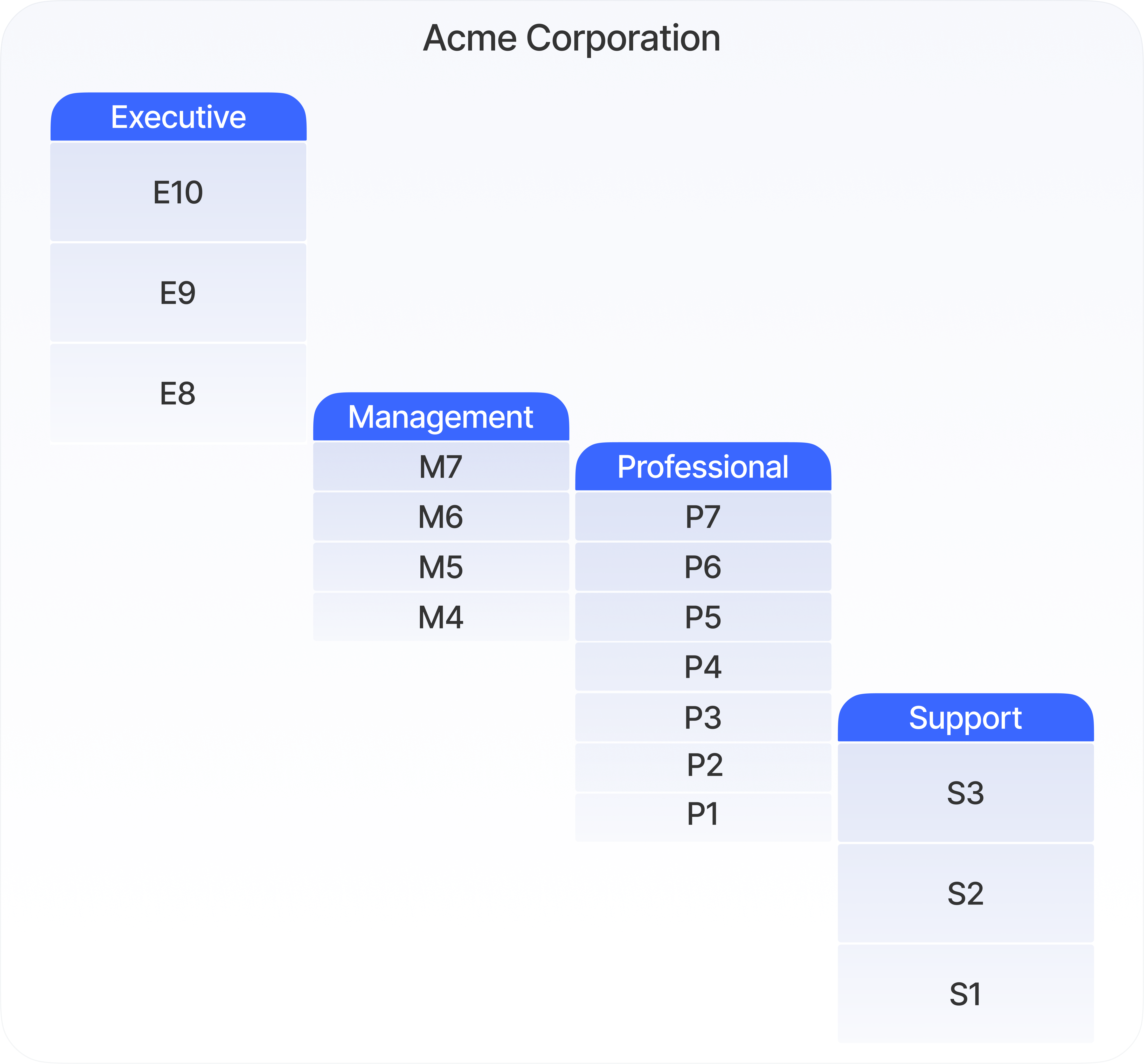
There is a deeper discussion later in this guide to help you decide whether to include maturity levels at all. Each cell holds a single pay number or a range. Starting with a single number is often a good idea in practice.
A matrix like this forces clear thinking. Every figure must fit inside a clean progression and every number must be chosen deliberately.
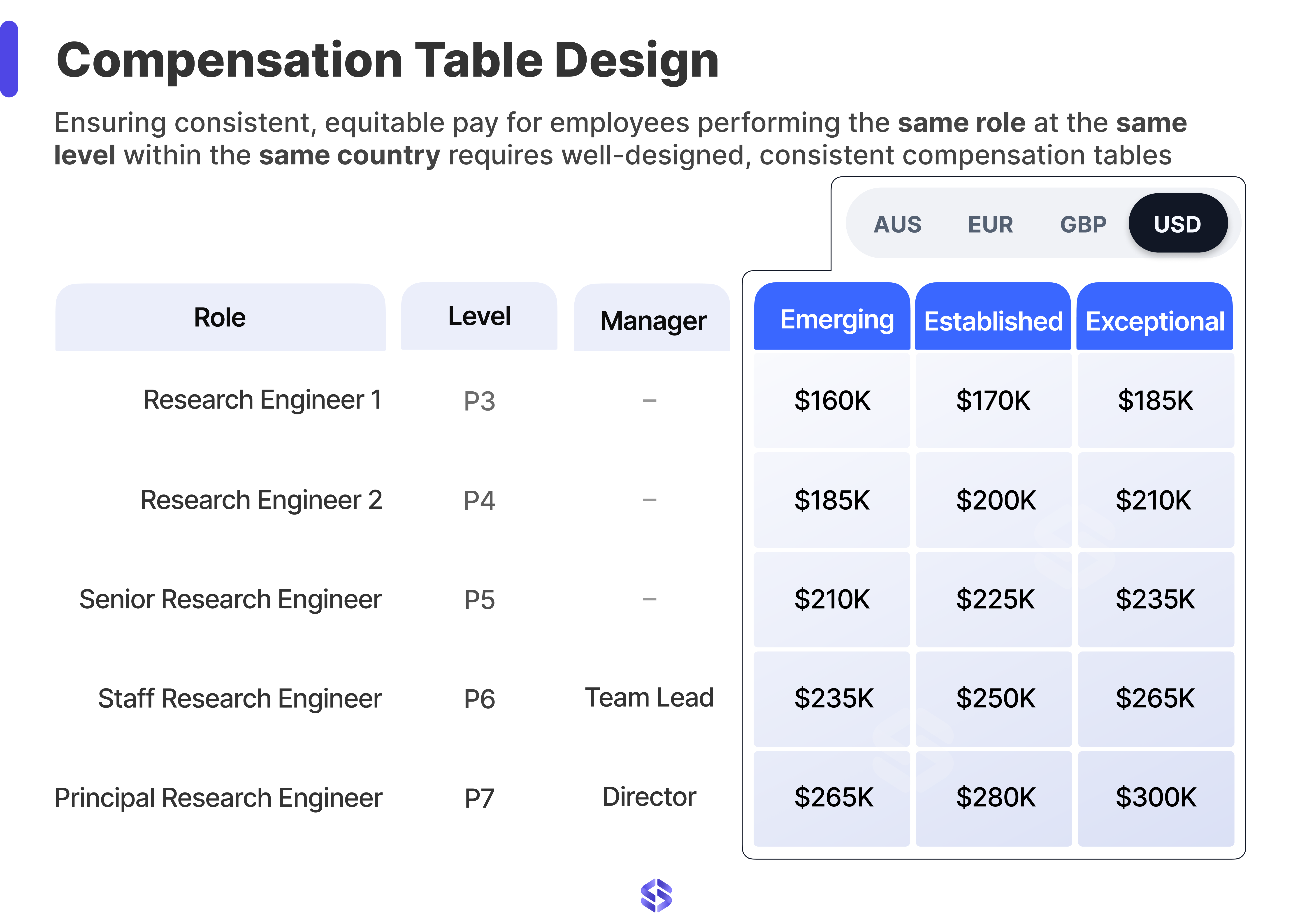
Step 2: Assign Target Percentiles for Each Maturity Band
Anchor the maturity bands to market percentiles. For example,
Emerging aligns with the 50th percentile
Established aligns with the 75th to 80th percentile
Exceptional aligns with the 90th percentile
Anchoring the columns to concrete market points shapes the curve of the entire system. It gives structure to the vertical and horizontal progression the matrix needs.
Step 3: Pull All Benchmark Data… Then Accept the Chaos
Market data rarely behaves. Junior 90th percentile figures often sit above Senior 50th percentile values. Families overlap across levels.Percentile lines cross in ways that break naïve level structures.
Raw benchmarks create jagged edges. A salary system needs to resolve that chaos into a coherent ladder. Sophare AI recommends Pave for the most reliable and defensible real-time benchmarking data. A free alternative is to use self-reported salary data from sites like Levels.fyi, though those figures are typically inflated by about 3–10% depending on the role.
Step 4: Normalize and Flatten the Data to Force Upward Progression
The next step is the craft. Compensation teams smooth the raw market data until the entire matrix moves upward without exception. The smoothing process converts irregular benchmarks into a clean, monotonic architecture.
This includes:
- Removing outliers that distort the curve
- Compressing gaps that are too wide
- Raising low points that break progression
- Lowering high points that introduce jumps
- Ensuring each row increases as levels increase
Step 5: Build the Final Monotonic Table
After normalization, every number moves in one direction. Inside a level, each maturity step rises cleanly. Across levels, each progression sits above the one before it. The result is a coherent pay ladder that matches how careers actually progress.
Step 6: Share the Table Internally to Enforce Discipline
Publishing your compensation table internally promotes transparency and structural discipline. Once shared, the structure becomes self-governing because any exception becomes immediately visible. Teams see that bending the rules disrupts the entire framework, so deviations become rare. Regular audits keep the progression intact, and employees quickly notice when something doesn’t align with the logic of the system and should be allowed to raise inconsistencies. Most companies run six-month spot audits to offset from performance cycles and to detect anomalies early.
If you grant exceptions to the table, track them. Tracking exceptions keeps your system honest, data-driven, and helps you catch creeping inconsistencies long before they turn into costly re-levels, equity fixes, or regulatory headaches.
Part 3: To Pay for Performance or Not?
Pay and performance are independent forces—strong performance doesn’t automatically require higher pay, and higher pay doesn’t automatically produce stronger performance. You can pay more and more and more to an employee and they likely will hit a limitation on where their performance will max out. For example, promoting a stellar employee who has been a consistent top performer from their individual contributor (IC) role into a management track may be an obvious move. Your employee gets to “grow” in their career and you benefit because this talented professional should be able to jump right in and manage a team flawlessly, right? There’s one snag: not all great individual contributors are naturally great managers, nor might they even want to manage! Great managers often dedicate time & energy by attending management training and coaching. On top of that, there’s a well-known concept of “The Peter Principle” where promotions that have been decided due to past performance may necessarily equate to incredible managerial abilities. It’s also so much easier, faster, and cheaper to promote a beloved employee into a manager role than to hire externally for the leader. Time and time again we see promotion decisions for truly wonderful talent happen just because that’s the next level or pay increase available. Then at a certain point the promoted employee is unable to be successful and either burns out or exits the organization to find a role that’s a better fit for their skills & interests. The sales professional who crushes their quota every quarter may not necessarily have skills to be a great sales leader, or the data engineer who can practically build a data pipeline with their eyes closed may not have the skills to manage a team of engineers!
A more intentional compensation strategy anticipates the Peter Principle and helps teams avoid promoting great talent into roles where they cannot thrive. As outlined above, one way to do this is by embedding performance into the structure itself. Use segments within each range: “emerging” for employees still growing into the role, “established” for those consistently meeting expectations, and “exceptional” for those operating above the bar. This gives employees room to grow without forcing promotions as the only path to higher pay. You can still promote ICs into manager roles when they show the right traits and interest in leading, while keeping top ICs who love hands-on work motivated with continued compensation growth inside their track.
Part 4: Sophare is AI for Total Compensation Design
Total Compensation Design brings variable pay, equity, and benefits together into one coherent, end-to-end compensation system. Base pay and salary ranges are only one part of how employees experience compensation. A scalable system needs to spell out how variable pay (e.g. bonuses), equity (e.g. stock), and benefits (e.g. perks) fit alongside base pay so teams make consistent decisions and employees understand the full picture. AI now plays a big role in modern compensation design, and Sophare AI brings the structure, clarity, and scale that Total Compensation Design demands.
Variable pay and allowances
Define where variable components sit relative to salary ranges across all roles. For sales, support, engineering, and on-call roles, clarify which elements are inside the range and which sit on top of it. This prevents confusion about what a range actually represents and avoids using allowances or commissions to mask below-market salaries.
Sophare’s research shows that the largest source of pay bias uncovered during pay transparency and gender-pay-gap reporting isn’t base salary at all. The largest biases hide in variable pay. Bonus and incentive structures are where inconsistencies, subjective decisions, and legacy practices most often create gaps that later turn into PR issues once reported publicly. Sophare’s AI flags these pay gaps early so teams can correct them before they surface in reports or employee perception.
Equity refresh and long-term value
Equity shouldn’t feel like a one-time grant. Document level-based equity guidelines and refresh logic so employees see how progression, impact, and long-term value creation map to ongoing equity awards. Clear refresh rules reinforce your job architecture and help people connect their growth to long-term ownership.
Benefits as a market lever
Benefits can be a powerful hiring and retention tool when designed intentionally. Offer country-appropriate benefits that align with local expectations and talent-market dynamics, not vanity perks that add cost without impact. Set decision criteria and a review cadence so benefits remain consistent, defensible, and tied to what actually helps teams succeed. Sophare helps compensation teams compare benefit mixes across countries, evaluate cost effectiveness, and surface imbalances that undermine internal equity.
The Next Frontier in Compensation: Total Compensation Design 🤝 Scenario Modeling
Today, compensation teams make big decisions with limited visibility:
- “What happens if we move Engineering to the 75th percentile?”
- “What happens if we refresh equity earlier for high performers?”
- “What happens if we give spot bonuses to AI engineers being poached by competitors?”
- “How does a new EU directive change our total comp structure for 2026?”
Sophare is the leading AI-native scenario engine for compensation. Sophare allows teams to simulate:
- Range changes and market shifts
- Pay-equity implications
- Equity refresh cycles
- Country-by-country compliance risk
- Budget impact
- Workforce-wide outcomes
Sophare's scenario-enabled compensation planning is the biggest innovation to Total Rewards teams and will remain so for decades to come.